

Reinvestment is defined as the practice of using dividends, interest, or other earnings to purchase additional shares or assets rather than taking cash. This process accelerates passive income through compounding, where each reinvested dollar generates its own future returns. Platforms like Fidelity and Saxo have built entire educational frameworks around this principle because the math is unambiguous. Dividends can account for up to 84% of total long-term investment returns when reinvested consistently. That single figure explains why reinvestment accelerates passive earnings more than almost any other strategy available to individual investors.
How does reinvestment leverage compounding to accelerate passive income?
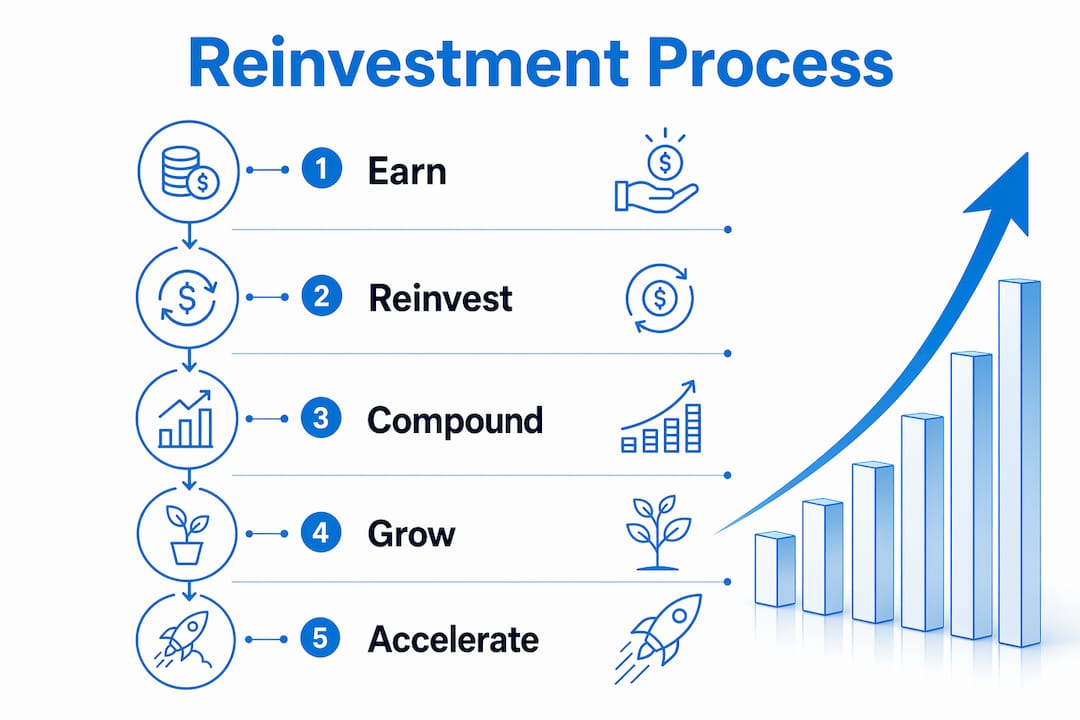
Compounding is the mechanism that makes reinvestment so powerful. When you reinvest dividends, you buy more shares, and those shares generate their own dividends, which you reinvest again. The cycle repeats, and your income base grows with each pass.
Dividend Reinvestment Plans, commonly called DRIPs, are the standard vehicle for this process. A DRIP automatically routes dividend payments back into the same stock or fund, purchasing additional shares on your behalf. Over a 20-year horizon, yields on original cost can exceed 10% through consistent reinvestment. That means a position paying 3% today could effectively pay you more than 10% on your original investment two decades from now.

The table below shows the difference compounding makes over time, using a simplified illustration.
| Scenario | Starting value | After 10 years | After 20 years |
|---|---|---|---|
| No reinvestment (cash dividends) | $10,000 | $10,000 + cash collected | $10,000 + cash collected |
| Full reinvestment via DRIP | $10,000 | Larger share base | Significantly larger share base |
The reinvestment column grows because each dividend buys shares that produce future dividends. The cash column stays flat in terms of invested capital.
Pro Tip: Start reinvestment as early as possible in your investing timeline. The compounding effect is exponential, not linear, so the first decade of reinvestment does more long-term work than the last.
What are the practical benefits of reinvestment strategies?
Reinvestment strategies offer concrete, measurable advantages beyond simple growth. Understanding each benefit helps you decide how to structure your portfolio for maximum passive income.
- Automated dollar-cost averaging. Reinvesting dividends acts as automated dollar-cost averaging, reducing timing risk by spreading purchases across different price points. You buy more shares when prices are low and fewer when prices are high, without making any active decisions.
- Fractional share purchases. Brokerages supporting fractional share purchases allow full utilization of every dividend dollar immediately. You never leave cash sitting idle waiting to accumulate enough for a full share.
- Commission-free transactions. DRIPs often offer commission-free purchases and sometimes discounted share prices. That cost efficiency compounds over time, since every dollar saved on fees stays invested.
- Behavioral protection. Automatic reinvestment removes emotional temptations to spend dividends. When the money never hits your checking account, you never face the decision to spend it.
- Alignment with passive investing goals. Reinvestment requires no active management once activated. It fits naturally into a passive income strategy because it works in the background without your ongoing attention.
Pro Tip: Check your brokerage account settings today. Most brokerage accounts default to cash payouts, and failing to activate automatic reinvestment is the primary reason investors miss out on compounding benefits.
What risks should investors consider when reinvesting passive earnings?
Reinvestment is not without trade-offs. A balanced view of the risks helps you manage your portfolio responsibly while still capturing the capital growth through reinvestment that compounding provides.
- Concentration risk. Reinvestment increases exposure to underlying assets, which raises concentration risk if not monitored. If you reinvest all dividends from a single stock, that position grows larger relative to your total portfolio over time.
- Tax implications. Reinvested dividends remain taxable in most non-retirement accounts in the year they are paid, even though you never received cash. You owe taxes on income you immediately put back to work, which requires planning.
- Illiquidity for income-dependent investors. Retirees or investors who need regular cash flow may find full reinvestment counterproductive. If your dividends are your living expenses, reinvesting them creates a cash shortfall.
- Behavioral drift. Some investors treat dividends as spendable income without a formal plan. Without automatic reinvestment activated, the behavioral risk of spending those earnings is real and measurable.
- Diversification neglect. Reinvestment strategies can quietly tilt your portfolio toward whichever assets pay the highest dividends. Periodic rebalancing corrects this drift before it creates meaningful risk.
Monitoring your portfolio concentration every quarter is a practical safeguard. If any single position grows beyond your intended allocation because of reinvestment, redirect future dividends toward underweighted assets instead.
How can investors implement reinvestment for long-term passive income growth?
Setting up reinvestment correctly from the start determines how much compounding benefit you actually capture. The steps below apply to most major brokerages, including Fidelity, Charles Schwab, and Vanguard.
Activating your DRIP
Log into your brokerage account and locate the dividend reinvestment settings. At Fidelity, this option appears under “Account Features” for each eligible position. Select automatic reinvestment for every position where you want compounding to work. Confirm the setting is saved, since some platforms require separate confirmation for each holding.
Choosing which accounts to reinvest in
Tax-advantaged accounts like IRAs and 401(k)s are the best place to reinvest dividends. Reinvested dividends in these accounts grow without triggering annual tax bills, which accelerates compounding significantly. In taxable accounts, reinvestment still makes sense for long-term growth investors, but you need to track the cost basis of each reinvested purchase for accurate tax reporting.
Balancing reinvestment with income needs
Not every investor should reinvest 100% of dividends. A practical framework separates your portfolio into two buckets: a growth bucket where all dividends are reinvested, and an income bucket where dividends are paid as cash to cover living expenses. This structure lets you capture compounding benefits while meeting real cash needs.
The table below compares reinvestment behavior across common account types.
| Account type | Tax on reinvested dividends | Compounding efficiency | Best for |
|---|---|---|---|
| Traditional IRA | Deferred until withdrawal | High | Long-term growth investors |
| Roth IRA | None (qualified withdrawals) | Highest | Young investors with long horizons |
| Taxable brokerage | Taxable in year paid | Moderate | Investors with tax-loss harvesting plans |
| 401(k) | Deferred until withdrawal | High | Employer-sponsored retirement savers |
Using automatic reinvestment as a behavioral tool
Reinvestment strategies act as forced saving mechanisms, keeping investors from spending dividends and staying invested for long-term growth. Automation removes the decision entirely. When you never see the dividend as spendable cash, you never make the mistake of spending it. This behavioral advantage is underappreciated by most investors who focus only on the math.
Reinvesting dividends instead of taking cash can accelerate reaching financial goals by building a larger invested balance over time. Chase frames this as one of the most reliable paths to financial freedom through reinvestment for individual investors who stay consistent.
Key Takeaways
Reinvestment accelerates passive earnings because each reinvested dollar buys assets that generate future income, creating a compounding cycle that grows your earnings base faster than any single rate of return alone.
| Point | Details |
|---|---|
| Compounding drives growth | Reinvested dividends buy more shares, which produce more dividends, accelerating income over time. |
| Activate automatic reinvestment | Most brokerages default to cash payouts, so you must manually enable DRIP settings to capture compounding. |
| Manage concentration risk | Reinvestment increases exposure to individual assets, requiring quarterly portfolio reviews and rebalancing. |
| Use tax-advantaged accounts first | IRAs and 401(k)s eliminate annual tax drag on reinvested dividends, maximizing compounding efficiency. |
| Automation protects behavior | Automatic reinvestment removes the temptation to spend dividends, keeping your capital working consistently. |
Why I think most investors underestimate the behavioral side of reinvestment
The math of compounding gets most of the attention, and the math deserves it. But after observing how individual investors actually behave, I am convinced the behavioral dimension of reinvestment is equally important and far less discussed.
Most investors know they should reinvest dividends. Few actually do it consistently. The problem is not knowledge. The problem is that dividends feel like found money. When a $200 dividend lands in your account, spending it on something tangible feels more satisfying than watching a fractional share purchase happen automatically. That impulse is the single biggest damage to long-term compounding that most investors never account for.
Automation solves this completely. When you activate a DRIP, the decision is made once, and then it never needs to be made again. I have seen investors with modest portfolios outperform more sophisticated investors simply because their reinvestment ran on autopilot while others kept interrupting the process.
Starting early matters more than starting with a large amount. A $5,000 portfolio with full reinvestment activated at age 25 will likely outperform a $50,000 portfolio started at 45 with inconsistent reinvestment. Time and consistency beat capital size when compounding is involved.
My practical advice: review your concentration risk every quarter, not just your returns. Reinvestment quietly tilts your portfolio, and most investors only notice the tilt after it has already created a problem. Fractional share tools from brokerages like Fidelity and Charles Schwab make it easy to redirect dividends across multiple positions, so use them.
— Abdur
Investandearn resources for reinvestment and passive income
Investandearn is built for investors who want clear, practical guidance on growing passive income through reinvestment and related strategies.

The platform offers tailored investment frameworks that simplify the process for beginners and experienced investors alike. Case studies on the site show real examples of how reinvestment compounds returns over time, including scenarios where a $100 starting investment generates measurable passive earnings. If you want structured guidance on passive income strategies, the Investandearn resource hub covers reinvestment mechanics, portfolio setup, and income growth in plain language. You can also review the about Investandearn page to understand the platform’s mission and how it approaches investment education.
FAQ
What is reinvestment in simple terms?
Reinvestment is the practice of using dividends, interest, or other investment earnings to purchase additional shares or assets instead of taking cash. This process grows your invested base over time through compounding.
Why do reinvested dividends grow faster than cash dividends?
Reinvested dividends buy more shares, and those shares generate their own dividends. This cycle compounds your income base, while cash dividends leave your invested capital unchanged.
What is a DRIP and how does it work?
A Dividend Reinvestment Plan (DRIP) automatically uses your dividend payments to buy additional shares of the same investment. Many brokerages offer DRIPs with no commission fees, and some provide fractional shares so every dividend dollar is put to work immediately.
Are reinvested dividends taxable?
Reinvested dividends are taxable in the year they are paid in most taxable brokerage accounts, even though you did not receive cash. Using tax-advantaged accounts like IRAs defers or eliminates this tax, improving compounding efficiency.
How do I start reinvesting dividends?
Log into your brokerage account and enable automatic dividend reinvestment in your account settings. Fidelity, Charles Schwab, and Vanguard all offer this feature, and activating it takes only a few minutes.
Post a Comment
0Comments